Foldable Water Bottle
A foldable water bottle fixes this completely, but I only figured that out embarrassingly recently.
I have a packing list for travel. A real one, on my phone, refined over about forty trips. It has categories. It has checkboxes. It has a note at the bottom that says "CHECK THE CHARGER" in caps because apparently past-me did not trust future-me. And still, at least twice a year, I end up buying a bottle of water at an airport for €3.50 that I drink in four minutes and throw away before security.
The bottle isn't on my list. Not the foldable water bottle one I own, anyway. Because my reusable bottle is fine when I'm hiking or at the gym, but it's a rigid 750ml tank that takes up a third of my daypack when it's full and exactly the same amount of space when it's empty. So somewhere between "I should bring this" and "I need to fit four days of clothes in a carry-on," it gets left behind.
This is a solved problem. I just didn't know it for an embarrassingly long time.
Why your water bottle stays home
The issue isn't forgetting. It's the empty-bottle problem. Once you've drunk your water, a hard bottle doesn't get smaller. It just sits there, taking up the same real estate it did when it was useful, now contributing nothing except guilt about buying that €3.50 airport water anyway.
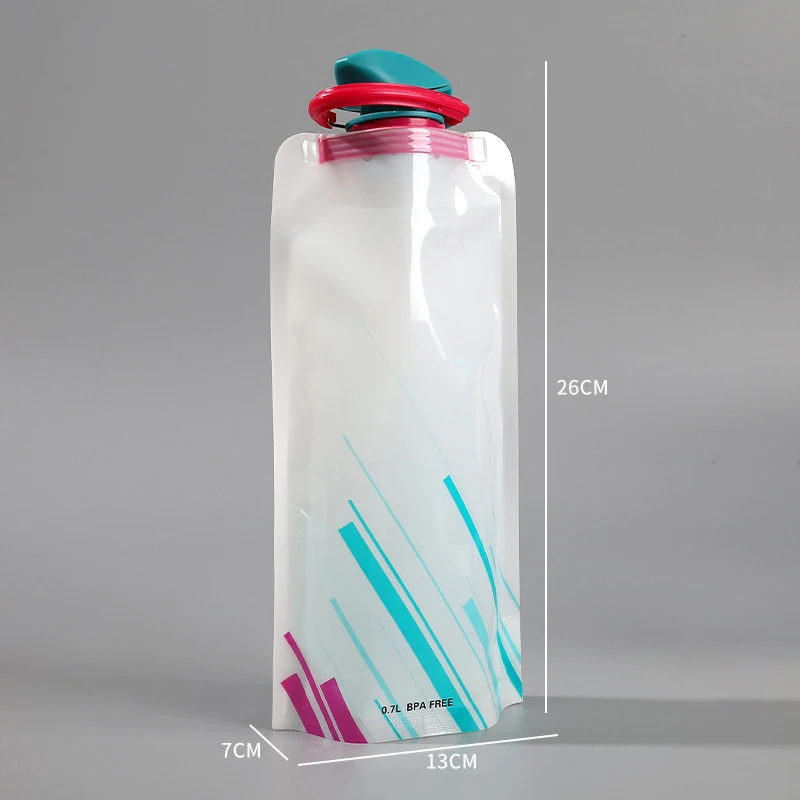
Foldable silicone bottles collapse when they're empty. Completely flat. You can fold one into a jacket pocket, clip it to a keyring, stuff it into the small front pocket of a backpack you'd normally use for nothing except receipts. When you need it, you fill it. When you don't, it's barely there.
That's it. That's the whole thing.
What to actually look for
Not all collapsible bottles are equal, and a few of them will leak on you in a way that ruins a bag lining and your entire opinion of the category. A few things worth checking before you buy:
The cap matters more than the bottle. Look for a screw top with a silicone seal rather than a push-pull spout. Push-pull caps are fine for rigid bottles where the structure keeps things stable, but on a soft bottle they're more likely to let water through when the bottle gets compressed in a bag.
Carabiner clips are genuinely useful. Not in an Instagram-outdoorsy way, but practically: clip it to the outside of your bag when you want to fill it at a fountain and not have to dig through everything first. Small thing, but you'll use it.
Food-grade silicone doesn't taste like anything. Cheaper materials sometimes do, especially when the bottle is new. If you notice a chemical taste in the first week, it usually fades. If it doesn't, that's a sign the silicone quality isn't great.
600ml is the right size for most situations. Big enough to matter, small enough to fold into something you'll actually carry.
Where it actually fits into your life
The obvious one is travel. Through-security-empty, refill-at-the-fountain, done. But honestly the more useful application is the everyday stuff: the gym bag that's already full, the commute bag where a full-size bottle just isn't happening, the Saturday market where you wish you had water and didn't plan ahead.
It's also just a cheaper habit than you'd think. A €3.50 airport water twice a month is €84 a year. A foldable bottle costs less than two of those.
The actual packing tip
Put it in a place you use every day before the trip. Not in your suitcase, not "somewhere you'll remember." In your work bag or your jacket pocket, living there. Then when you pack, you're not remembering to add something, you're just noticing it's already with you.
The charger thing is still on me.
FAQ
Where can I buy a collapsible water bottle in Spain? Online is your easiest option. Look for shops that ship within Spain in 2 to 4 days. Decathlon stocks silicone soft flasks in-store, though these tend to be positioned as running or trail gear rather than travel accessories.
Is silicone safe for drinking water? Food-grade silicone is approved for contact with food and drink across the EU. It doesn't leach chemicals into water, doesn't retain flavours, and is BPA-free. The key phrase to look for is "food-grade" rather than just "silicone."
How do you clean a foldable bottle? Turn it inside out if you can, wash with warm soapy water, rinse well, and let it dry fully before folding it away. Most are also dishwasher safe on the top rack.
Does it actually fold flat? A good silicone bottle folds to about the thickness of a folded t-shirt. If the walls are thick enough to hold shape when empty, that's a sign the silicone quality is lower. It should collapse with almost no resistance.
Can you put hot drinks in it? Food-grade silicone handles heat well, but most foldable bottles aren't designed for boiling liquids. Warm tea or coffee is usually fine. Check the specific temperature rating of whatever you buy.